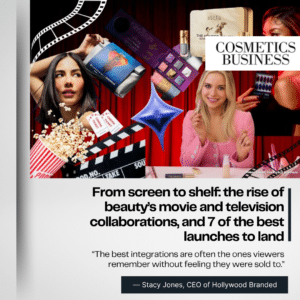
Article Title: From screen to shelf: the rise of beauty’s movie and television collaborations, and 7 of the best launches to land
Outlet: Cosmetics Business
Reporter: Lollie Hancock
Published: September 18, 2026
Beauty Brands Are Moving From Screen to Shelf
Beauty and entertainment have always shared a powerful connection, but that relationship is becoming increasingly strategic. In her Cosmetics Business feature, reporter Lollie Hancock explores how beauty brands are tapping into blockbuster films, bingeable television series, and established fandoms through sponsorships, product placement, licensing collaborations, and limited-edition collections.
Our agency’s founder and CEO, Stacy Jones, joined other industry experts to explain why the relationship works so naturally and what separates an authentic entertainment partnership from a placement that feels forced.
As Stacy explains:
“Beauty is visual, emotional, and identity-driven, which makes it a natural fit for entertainment.”
Film and television do more than entertain. Characters, aesthetics, transformations, costumes, hair, and makeup can all become part of how audiences experience and identify with a story. Beauty brands have an unusual opportunity to turn that emotional connection into something consumers can actually use themselves.
Authentic Integration Comes First
The article highlights an essential lesson for brands considering product placement: visibility alone is not enough.
Audiences are highly attuned to integrations that feel unnatural. A beauty product needs to belong within the character’s life, environment, and story rather than simply appearing because a brand secured screen time.
Stacy puts it plainly:
“Audiences can spot a forced placement immediately.”
She adds:
“The product needs to make sense for the character, location, moment, and production design. It should support the scene, not interrupt it.”
That distinction is central to Hollywood Branded’s approach to entertainment marketing. The objective is not simply getting a product onto a screen. It’s finding a creative alignment where the brand contributes to the story and becomes part of a cultural moment audiences already care about.
As Stacy notes:
“The best integrations are often the ones viewers remember without feeling they were sold to.”
From Product Placement to Full Entertainment Ecosystems
One of the biggest opportunities extends beyond what audiences see on screen.
A beauty partnership can start with product placement and expand into premiere sponsorships, red-carpet beauty moments, creator campaigns, tutorials, limited-edition products, licensed merchandise, retail displays, and social content.
The article points to partnerships surrounding properties including Euphoria, Star Wars, Harry Potter, The Hunger Games, Bridgerton, and the Legally Blonde prequel Elle. These collaborations demonstrate how entertainment IP can move beyond the screen and into products consumers can personally experience.
For Hollywood Branded, this is where entertainment partnerships become particularly powerful: a placement can become the foundation for a larger, integrated campaign instead of functioning as a one-off exposure.
Giving Fans a Piece of the Story
Licensed products offer another advantage: they make fandom tangible.
Stacy explains that entertainment-inspired collections “let consumers take a piece of the cinematic universe home.”
Beauty provides brands with especially rich creative territory:
“For beauty, collections can be especially rich: shade names, packaging, tutorials, talent or make-up-artist storytelling, display moments, and creator recreations all help expand the universe.”
The result can be much more than branded packaging. Done strategically, a collection gives consumers another way to express their connection to a character, aesthetic, era, or story world.
The Product Still Has to Deliver
Fandom may create attention and urgency, but it cannot compensate for a weak product.
As Stacy cautions:
“A strong collection creates urgency and collectability, but it still has to deliver as a beauty product.”
And:
“If the quality, shades, or utility do not stand on their own, consumers will see it as a novelty rather than something worth repurchasing.”
That’s an important takeaway for any brand considering an entertainment licensing partnership. IP can accelerate awareness and purchase interest, but long-term value depends on creating something consumers genuinely want after the excitement surrounding the collaboration fades.
The Hollywood Branded Perspective
These strategies sit directly at the intersection of Hollywood Branded’s expertise. The agency connects brands, talent, productions, and entertainment IP through product placement, licensing partnerships, branded content, celebrity and influencer campaigns, co-promotions, PR, media, and experiential activations.
The strongest entertainment partnerships aren’t simply about putting a logo next to something popular. They’re about finding the right cultural fit, building an authentic creative connection, and then amplifying that partnership across multiple consumer touchpoints.
Beauty’s growing relationship with Hollywood is a strong example of what can happen when those pieces come together.
Want to make your brand part of the entertainment audiences already love?
Explore more pop culture marketing insights from Hollywood Branded: Hollywood Branded’s Insights Blog
Read the Original Article: From screen to shelf: the rise of beauty’s movie and television collaborations, and 7 of the best launches to land